

 2026-04-30
 131
131 From decoupling and filtering to energy storage and signal stability, MLCCs play a critical role in consumer electronics, automotive systems, industrial equipment, AI servers, and communication infrastructure.
In 2026, demand for MLCCs has reached a new high, driven largely by the rapid expansion of AI infrastructure. According to your source text, a single AI server based on the NVIDIA GB300 platform may require around 30,000 MLCCs, while a full rack can consume up to 450,000 units. As a result, procurement teams are facing tighter supply, selective price increases, and growing pressure to identify reliable multilayer ceramic capacitor manufacturers.
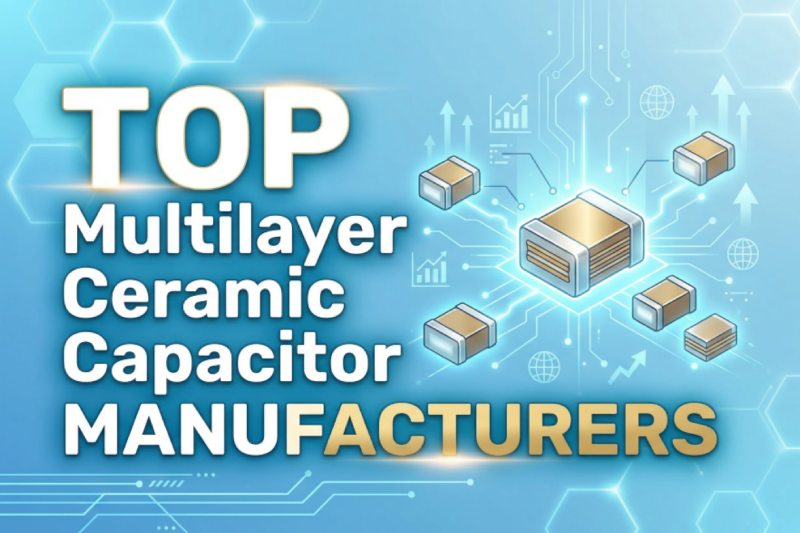
The global MLCC market remains highly concentrated among a few top-tier manufacturers with strong expertise in materials science, miniaturization, and high-reliability production. These companies are shaping the future of AI servers, EVs, industrial control systems, and high-performance communications.
Murata remains the benchmark in the MLCC industry and continues to dominate the high-end market, especially in automotive-grade applications. The company focuses on high-reliability, ultra-miniature, and high-capacitance MLCCs for AI servers, electric vehicles, and advanced electronics.
Murata continues to push the limits of miniaturization and capacitance density, including ultra-small package development and high-layer-count MLCC technology. Strong demand from AI infrastructure is also driving high utilization rates across its advanced production lines. According to your draft, Murata announced a price increase of 15% to 35% for selected categories, effective April 2026.
Samsung Electro-Mechanics is one of the most competitive global MLCC suppliers, backed by strong semiconductor and manufacturing expertise. The company is expanding aggressively into automotive, AI server, and high-voltage applications.
Its production sites in Busan, Tianjin, and the Philippines are operating at high utilization, and an additional plant in the Philippines is planned to support future demand. Samsung is also advancing soft termination technology and high-voltage MLCC solutions for EV power systems. Your source text notes that Samsung began evaluating price increases in early 2026, with formal adjustments expected from April.
Taiyo Yuden is steadily shifting toward higher-value sectors such as automotive electronics, communication infrastructure, and AI-related applications. Rather than focusing only on expansion, the company is also improving profitability through product mix optimization.
Its portfolio includes embedded MLCC solutions for AI servers and high-voltage products for EV traction inverter applications. With stable utilization and targeted product innovation, Taiyo Yuden remains an important supplier in the advanced MLCC segment.
TDK is a major force in high-voltage MLCCs and soft termination technologies, particularly for automotive safety systems and industrial applications. The company continues to invest in cleanroom expansion and advanced production facilities to support rising demand from EV and ADAS markets.
Its product innovations include high-density MLCCs for demanding voltage environments and resin-coated solutions designed to perform reliably under severe thermal cycling conditions. TDK remains one of the most trusted names for high-reliability applications.
Kyocera AVX is a key supplier in high-reliability sectors such as aerospace, defense, and medical electronics. By strengthening manufacturing capacity in the United States and expanding production for low-ESL MLCCs, the company is improving its position in both mission-critical and AI-related markets.
Its product range also includes high-capacitance miniature MLCCs for wearables, 5G devices, and compact electronics. Strategic portfolio expansion has further enhanced its presence in EV and powertrain applications.
Yageo has evolved from a large-volume passive component supplier into a more diversified high-end solutions provider. Through acquisitions such as KEMET and Pulse Electronics, the company has expanded its strength in automotive, industrial, aerospace, and communication applications.
The company is investing heavily in production expansion and high-end manufacturing, while also benefiting from strong AI-driven demand. According to your original draft, Yageo has selectively raised prices for certain high-voltage, high-capacitance, and automotive MLCC products.
Walsin Technology is accelerating its move into automotive and high-end MLCC applications through capacity expansion in Taiwan and Malaysia. The company is also increasing its participation in AI server supply chains, focusing on higher-margin and higher-specification MLCC categories.
Its collaboration in next-generation power electronics further strengthens its long-term positioning in industrial and EV-related applications. Although no formal MLCC price increase was noted in your text, related passive component pricing has already moved upward in 2026.
In today’s tighter supply environment, selecting among MLCC manufacturers requires more than comparing unit prices. Buyers need to evaluate lead time stability, technical capability, reliability standards, and long-term supply support.
The 2026 MLCC market shows strong divergence across product categories. Standard consumer-grade MLCCs remain under steady demand from consumer electronics and industrial applications, while AI infrastructure, data centers, and automotive electronics are driving sharp growth in higher-spec parts.
As your original draft notes, many high-end MLCC lead times have extended from roughly 10–12 weeks to 14–16 weeks. In this environment, buyers should prioritize suppliers and distributors that can provide clear allocation visibility and dependable inventory planning.
The true competitive edge in MLCC manufacturing now lies in material control and process capability. When evaluating suppliers, key factors include:
Dielectric material quality and barium titanate formulation
Capability in ultra-thin dielectric layer production
Soft termination technology for vibration and board-flex resistance
Reliability in high-temperature, high-voltage, and high-frequency environments
For automotive, industrial, and server applications, these technical differences matter far more than simple price comparisons.
For high-reliability markets such as automotive electronics, industrial control systems, and AI servers, supplier certification is critical. AEC-Q200 qualification is often the minimum baseline for automotive applications.
OEMs should also consider building a multi-tier approved vendor list to balance premium Japanese suppliers with qualified alternatives from Taiwan and mainland China where appropriate. This can improve flexibility without sacrificing supply security.
As AI server demand continues to reshape the passive component market, rising raw material costs and tighter supply conditions are creating ongoing pressure for hardware manufacturers, OEMs, EMS providers, and system integrators.
AMS helps customers manage this volatility with professional component sourcing and supply chain support. With access to over 7,000 trusted global suppliers, AMS supports customers in securing reliable MLCC supply for both urgent and long-term procurement needs.
AMS provides:
Spot Stock and Buffer Management
When lead times from major manufacturers become too long, AMS leverages its global supply network to help secure immediate availability for AI-grade, automotive-grade, and industrial MLCCs.
Expert Cross-Referencing
If preferred Murata or Samsung parts are unavailable or overpriced, AMS can help identify suitable alternatives from manufacturers such as Yageo, Walsin, or Fenghua, while still meeting the necessary qualification requirements.
Price Stability Through Strategic Sourcing
With a global sourcing team and broad supplier access, AMS helps customers reduce exposure to short-term spot market volatility and improve cost control.
Supply Chain Continuity Support
AMS works closely with customers to reduce shortage risk, stabilize production schedules, and improve procurement resilience in a fast-changing market.
In 2026, selecting the right multilayer ceramic capacitor manufacturer is no longer only a technical decision. It is also a supply chain strategy decision.
As AI-driven demand continues to affect pricing, lead times, and product allocation, businesses need stronger sourcing visibility and more reliable procurement channels. By working with experienced manufacturers and a capable distribution partner, buyers can better protect both performance and continuity.
Contact AMS today for expert market insight and reliable MLCC sourcing support tailored to your business needs.

Copyright © 2026 AMS . All Rights Reserved