


 2026-04-30
 1810
1810 Solid state drives (SSDs) are no longer just storage devices. They have become the foundation of modern computing infrastructure. As AI workloads, cloud services, and data center demand continue to accelerate, solid state drive manufacturers are playing an increasingly critical role in global digital productivity.
This guide highlights the top SSD manufacturers to watch in 2026 and explores the key companies driving advances in storage density, performance, and enterprise reliability.
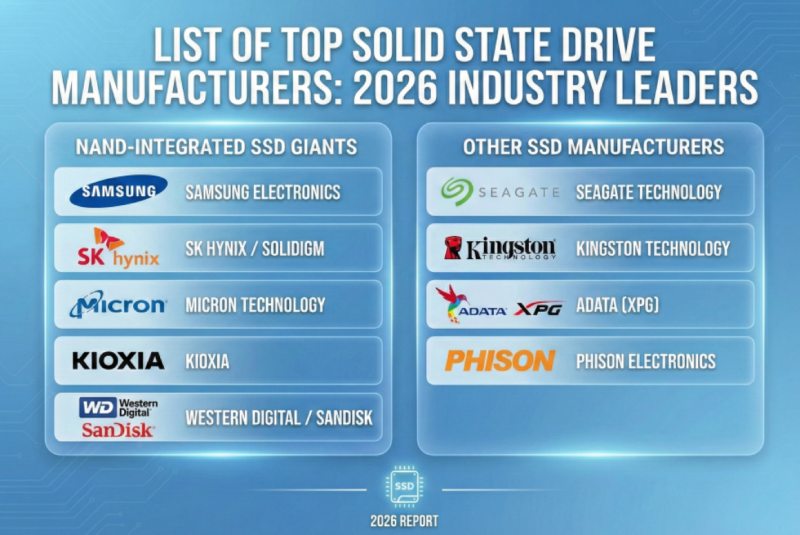
The most influential companies in the SSD industry are integrated device manufacturers (IDMs). These companies own and operate their own fabrication plants, allowing them to control the entire production chain from NAND flash wafer manufacturing to final SSD assembly.
Samsung remains the global leader in the NAND flash market. In 2026, the company continues to focus on high-value products such as HBM4 and enterprise-grade SSDs for AI and data center applications.
Its roadmap remains highly ambitious, with 400-layer NAND already entering mass production and a long-term path toward 1,000 layers by 2030. Samsung’s key SSD products include the PM1763 PCIe 6.0 SSD for enterprise environments and the 9100 Pro for consumer applications, both designed to deliver high throughput and strong performance for advanced computing workloads.
SK Group, including SK hynix and Solidigm, has reinforced its position as the world’s second-largest storage player, especially in the enterprise SSD segment. Solidigm has strategically shifted its focus away from the consumer market to concentrate on high-capacity enterprise solutions built for AI infrastructure.
The group has attracted industry attention with the 122.88TB D5-P5336 and plans to launch 245TB+ SSDs by the end of 2026. At the same time, SK hynix is working with NVIDIA on Storage Next, a next-generation SSD solution aimed at dramatically improving performance and IOPS capability.
Micron has established a strong position in automotive, industrial, and enterprise storage applications. It was among the first to introduce a PCIe 6.0 SSD, the Micron 9650, designed specifically for the bandwidth-intensive requirements of AI training servers.
Micron’s 232-layer QLC technology is also notable for delivering durability levels close to TLC in certain use cases, making it an attractive choice for customers that require both capacity and reliability.
Following its successful IPO, Kioxia continues to push storage density to new levels. In partnership with Western Digital, the company is developing advanced 3D NAND technologies that deliver higher interface speeds and improved power efficiency.
Its LC9 series offers up to 245.76TB of capacity, while the CM9 series supports PCIe 5.0. Kioxia is also developing ultra-high-performance SSDs designed for demanding applications such as high-frequency trading and real-time analytics.
After a major corporate split, the SanDisk brand now operates independently in the flash and SSD business. It remains a major supplier for AI data lake and enterprise storage environments.
Products such as the SN861 PCIe Gen5 SSD are specifically designed for AI model training and intensive enterprise workloads. To reduce risk amid 2026 market volatility, SanDisk is increasingly adopting long-term supply agreements with strategic partners.
Beyond NAND manufacturers, a number of module makers and controller specialists remain highly influential in the secondary and specialty SSD markets. These companies are often preferred by system integrators, industrial users, and performance-focused customers.
Although Seagate is best known for HDDs, it remains an important name in the SSD market in 2026. Its Nytro 5060 enterprise NVMe SSD supports high-speed caching for AI-driven workloads, while the FireCuda product line continues to serve gamers and high-performance workstation users.
Kingston is widely recognized for reliability and consistency. The KC3000 has gained attention for its low failure rate, while the Fury Renegade series delivers strong PCIe 4.0 performance for gaming, creative work, and professional applications. Kingston also offers enterprise storage solutions and consulting support for commercial customers.
ADATA, through its XPG gaming brand, remains a major global SSD supplier with strong visibility in both consumer and industrial markets. From high-performance PCIe Gen5 drives to industrial SSD solutions, ADATA offers competitive performance, broad product coverage, and strong value.
Phison is one of the most important behind-the-scenes forces in the SSD industry. In addition to offering its own solutions, it supplies controllers and firmware to multiple major SSD brands.
Its E26 Max14um controller powers many high-performance consumer SSDs, while the newer E31T controller, built on a 7 nm process, is helping drive faster and more power-efficient storage for laptops and compact devices.
The SSD market in 2026 is being shaped by both rapid technological progress and significant supply-side pressure.
SSD and NAND pricing are rising sharply. Enterprise SSD prices are expected to increase significantly, while overall NAND flash pricing is also under strong upward pressure. At the same time, suppliers are redirecting manufacturing capacity toward higher-margin DRAM and HBM products, which is tightening SSD availability across the broader market.
On the technology side, NAND is moving beyond 400 layers, while QLC is becoming increasingly mainstream in enterprise storage. Manufacturers such as Micron and Solidigm are helping prove that modern QLC can satisfy both endurance and performance requirements in many data center environments.
AI training and inference require huge amounts of low-latency data access, which is driving strong demand for ultra-high-capacity SSDs such as 122TB and 245TB models. At the same time, 5G, autonomous systems, and edge computing are increasing the need for high-performance localized storage.
While M.2 and U.2 remain widely used, EDSFF form factors such as E1.S and E3.S are attracting growing attention because they offer better thermal efficiency and higher storage density. PCIe 5.0 is still dominant in many AI server deployments, but PCIe 6.0 SSD platforms are beginning to emerge, signaling the next phase of SSD performance evolution.
In an era of rising SSD prices and extended lead times, working with a reliable procurement partner is more important than ever for OEM and EMS businesses.
AMS stands at the forefront of electronic component distribution and has built a strong reputation for supporting customers through global supply shortages. With access to more than 7,000 verified suppliers, AMS helps customers source constrained components, protect project timelines, and maintain supply continuity in a highly volatile market.
AMS provides:
Genuine, Franchised Guarantee: 100% authentic parts for mission-critical applications
Global Sourcing Expertise: Fast access to obsolete, shortage, and hard-to-find components
Rapid Response: BOM quotations delivered within approximately two hours
Industry-Wide Reach: Support across automotive, medical, telecommunications, IoT, and industrial markets
Our sourcing capability currently covers widely used M.2 NVMe models such as Kingston OM3PGP4512Q A0, OM3PDP3512B A01, and OM3PGP4512P A01, as well as data center and industrial storage solutions including Micron MTFDKBK512TGE 1BK1AABYY, MTFDKBK512TFK 1BC1AABYY, and Samsung U.2 NVMe SSDs such as MZQL23T8HCLS 00A07 and MZQL27T6HBLA 00A07. This helps ensure reliable supply for performance-critical applications.
As AI continues to reshape the storage industry, closely monitoring market trends, pricing shifts, and technology roadmaps is essential for making sound procurement decisions.
Whether you need ultra-high-density enterprise SSDs or dependable industrial storage modules, AMS provides the sourcing strength, market insight, and supply chain support required to secure your business.
Contact AMS today to leverage our global network for your storage sourcing needs.

Copyright © 2026 AMS . All Rights Reserved