The 2025 Malaysia Industrial Automation & Electronics Manufacturing Exhibition is the only professional industry event in Johor, part of the Malaysia-Singapore Special Economic Zone (JS-SEZ). Located in southern Malaysia, Johor is a key hub for electronics and high-tech manufacturing, serving as a gateway to Singapore and Southeast Asia.
Meet these exhibitors and more
The recent establishment of the “Johor-Singapore Special Economic Zone” through collaboration between the Malaysian and Singaporean governments will provide greater convenience and policy support for Chinese enterprises expanding into the Southeast Asian market. The manufacturing sector is poised to be one of the major beneficiaries of this initiative. With numerous large-scale modern factories set to launch in Johor, Malaysia is taking significant steps toward more efficient and advanced manufacturing processes.
This exhibition will bring together leading high-tech manufacturers, suppliers, and industry stakeholders from around the world to showcase the latest advancements in electronics manufacturing technology, machinery, robotics, automation control systems, industrial sensors, measurement and testing equipment, and more. Industry giants such as Omron, Schneider, and Autonics have already confirmed their participation.
【Date】 August 27–29, 2025
【Venue】 Johor International Convention Centre
Why Johor Instead of Kuala Lumpur?
Geographical Advantage: Johor is situated at the border between Malaysia and Singapore, close to Batam (Indonesia). Its strategic location makes it both a vital manufacturing base in Malaysia and a gateway to Singapore and Southeast Asian markets. It is home to one of the world’s busiest land borders—the Johor-Singapore Causeway and the Second Link. This geographical edge positions Johor as a core area for Malaysia-Singapore economic cooperation, attracting substantial cross-border investment and trade.
Policy Opportunities: The recently launched “Johor-Singapore Special Economic Zone (JS-SEZ)” offers incentives such as tax benefits, one-stop business services, and low-interest loans. Additionally, the “Forest City Financial Zone” (SFZ) has been established to attract international capital. The JS-SEZ also aims to streamline customs procedures, facilitate cross-border talent mobility, and enhance regional competitiveness. These measures will provide significant support for Chinese enterprises expanding into Southeast Asia, with the manufacturing sector standing to benefit greatly.
Diverse Manufacturing Clusters: Johor’s manufacturing industry spans multiple critical sectors, forming a comprehensive and diversified supply chain. Key areas include electronics and electrical products, metal processing and precision engineering, green technology and renewable energy, oil and gas, and food processing and manufacturing.
Major Projects and Opportunities: Large-scale initiatives such as IBTEC, the Gerbang Nusajaya Renewable Energy Industrial Park, solar and electric vehicle (EV) manufacturing projects by UEM Sunrise, Itranas, and CMEC, as well as new factories by companies like Panduit, are injecting new vitality into Johor’s industrial manufacturing sector, creating abundant employment and business opportunities.
Exhibition Scope:
Robotics & Technology: Industrial robots, service robots, robotic simulation and vision systems, related machinery and components; assembly and handling systems, linear positioning systems, industrial imaging processing systems, control systems, SCADA, sensors and actuators, industrial computers, communication networks, and fieldbus systems, embedded systems, measurement and testing systems, industrial automation data acquisition and identification systems, laser technology, automation services, pneumatic technology and equipment.
Electronics Manufacturing: Mounting technology and equipment, welding equipment, testing and measurement devices, dispensing/spraying equipment, connectors and plugs, other surface-mount technology (SMT) equipment, electronic materials & anti-static solutions.
Semiconductors: Semiconductor packaging and testing equipment, semiconductor materials, Mini LED production equipment and materials, electronic components, etc.
Electrical Systems: Transformers, batteries and uninterruptible power supplies (UPS), servo motors and frequency converters, transmission systems, mechanical drive systems, wires and cable accessories, electrical switchgear and equipment for control systems, electrical and optoelectronic components, power electrical testing and inspection equipment.
Microsystems Technology: Microsystem components, modular microsystems, microsensors, microactuators, micro-optics and fiber optics, micro-assembly, micro-joining technology, micro-reaction technology, microsystem design and modeling, micro-engineering, ultra-precision technology, other microsystem technologies.
Smart Factories & Automation: Finished product assembly automation integration, transmission/pneumatic equipment & accessories, motion control equipment, machine vision and sensing technology, industrial automation IT and control software, automation supporting equipment/accessories, automated warehousing and logistics, factory integration management software, industrial basic systems and production software, industrial LANs, etc.
We are excited to announce that AMS, a professional electronic components distributor and integrated global trading company, will be exhibiting at the 2025 Malaysia International Electronics Production Equipment & Industrial Automation Exhibition. Visit us to discover how we can support your supply chain and drive innovation in the fast-evolving electronics manufacturing sector.
About AMS
AMS is a leading provider of electronic components with regional operation centers in Hong Kong, Shenzhen, and Singapore. We leverage a highly efficient ERP software platform to innovate service models, optimize industry supply chains, and reduce costs. Our goal is to provide end-to-end procurement solutions for small and medium-sized enterprises in emerging technology fields.
Our Services & Strengths
Online and offline distribution of electronic components
Authorized sales of various ICs widely used in communications, instrumentation, aerospace, automotive electronics, and medical equipment
A skilled sales and technical support team with extensive industry expertise
A vast in-stock inventory valued at over RMB 500 million, ensuring prompt and reliable delivery
Strong market intelligence, cost-effective substitution recommendations, and value-added insights
Products and services widely supplied to customers in Europe, the US, Russia, Japan, Korea, as well as domestic electronic manufacturers and research institutes
Why Visit AMS at the Fair?
At our booth, you will learn more about our global sourcing capabilities and responsive service system that have earned us long-term partnerships with world-leading manufacturers. With a focus on continuous improvement and supply chain efficiency, we strive to exceed customer expectations at every turn.
Meet Us in Johor
We look forward to connecting with you at the Johor International Convention Centre from August 27 to 29, 2025. Discover how AMS can help you navigate the complexities of the electronics supply chain and support your growth in the Southeast Asian market.
In the evolutionary journey of the semiconductor industry, advanced packaging technologies have become a key driver for technological innovation and market growth. As traditional transistor scaling approaches its physical limits, the industry is turning to advanced packaging to achieve higher performance, lower power consumption, and more compact system designs. Yole’s report, “Status of the Advanced Packaging 2023,” provides an in-depth analysis of this transformative field, covering market dynamics, technology trends, supply chain challenges, and the impact of geopolitical factors on the global semiconductor industry.
The advanced packaging industry has experienced significant development since 2018, reaching new heights with continuous technological advancements and growing market demand. During this process, the industry has witnessed a shift from traditional packaging technologies to more advanced ones, including the development of innovative technologies such as 2.5D, 3D, System-in-Package (SiP), and Hybrid Bonding.
In 2022, the value of the advanced packaging market reached $44.3 billion, with an expected growth to over $78.6 billion by 2028, demonstrating a Compound Annual Growth Rate (CAGR) of 10% from 2022 to 2028. This growth is driven by key markets such as mobile and consumer electronics, automotive, and telecommunications infrastructure.
Technology trends indicate that advanced packaging technologies such as Flip-Chip, 2.5D/3D, and System-in-Package (SiP) will continue to dominate the market, with an expected market share of over 90% by 2028.
Regarding the impact of geopolitics on the supply chain, the current tense situation, especially the technological competition between the US and China, is leading to the restructuring of supply chains, prompting countries to seek strengthening of domestic supply chains and reducing reliance on external suppliers.
In the realm of modern technology, infrared (IR) sensors stand out as versatile and essential components across a wide array of applications. These sensors leverage the infrared part of the electromagnetic spectrum to detect and measure infrared radiation, which can be indicative of heat, motion, and various other parameters. This article delves into the fundamentals…
What is an infrared sensor ?
Infrared sensors detect radiation in the infrared spectrum, which ranges from about 750 nanometers (nm) to 1 millimeter (mm). Unlike visible light, infrared radiation is not visible to the human eye but can be felt as heat. IR sensors convert this radiation into an electrical signal that can be processed and interpreted by electronic systems.
How many types of IR sensors are there?
1. Active Infrared Sensors: These sensors emit their own infrared light and detect the reflected light. They are commonly used in proximity sensors and certain types of motion detectors. An example is the IR LED and photodiode pair, which measures changes in the reflected light to determine the presence of objects.
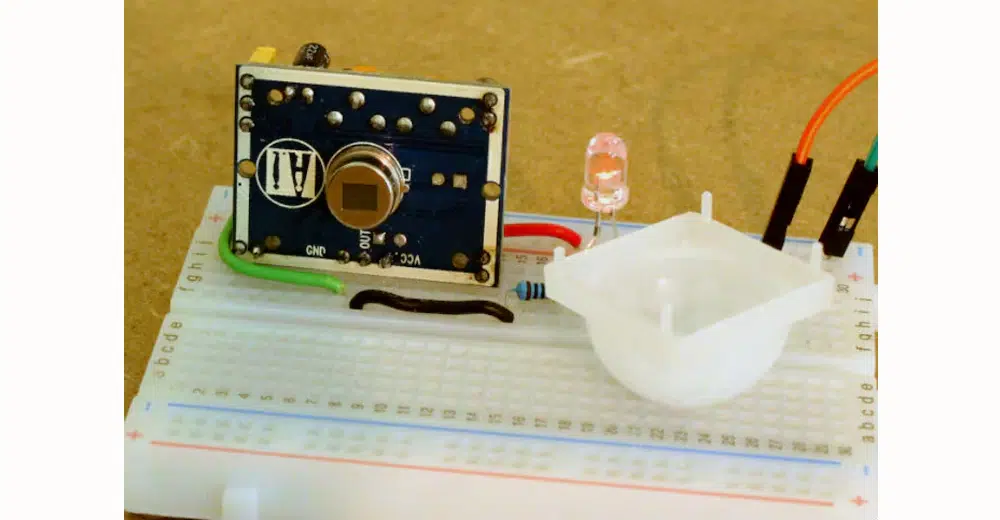
2. Passive Infrared Sensors (PIR): Unlike active sensors, PIR sensors do not emit any radiation. Instead, they detect the infrared radiation naturally emitted by objects. PIR sensors are widely used in motion detection applications, such as security systems and automatic lighting.
What is the purpose of the IR sensor?
IR sensors serve various purposes across multiple applications. Here are some common uses:
1. Proximity Detection – Used in devices like automatic doors, smartphones, and vehicles to detect nearby objects without physical contact.
2. Motion Detection – Common in security systems and alarms (e.g., PIR sensors) to sense movement in a defined area.
3. Temperature Measurement – Employed in non-contact thermometers to measure the temperature of objects or bodies from a distance.
4. Remote Controls – Found in TVs, air conditioners, and other electronics to facilitate wireless communication with remote controls.
5. Obstacle Avoidance – Used in robotics and drones to navigate and avoid collisions by detecting nearby objects.
6. Gas Detection – Some IR sensors can detect specific gases based on their absorption of infrared light, useful in industrial applications.
7. Night Vision and Thermal Imaging – Used in military, security, and surveillance applications to detect heat signatures in low-light conditions.
8. Data Transmission – In certain applications, IR can be used for wireless data transfer over short distances.
What is an infrared sensor used for?
Infrared sensors have a broad range of applications, benefiting various industries from consumer electronics to healthcare. Here are some notable examples:
1. Consumer Electronics: – Remote Controls: IR sensors are integral to remote control devices for televisions, air conditioners, and other home appliances. They receive signals from the remote control unit to perform the desired function. – Smartphones and Tablets: Some devices use IR sensors for facial recognition, which helps in unlocking screens and enhancing security.
2. Healthcare: – Thermography: Infrared thermography is used for non-invasive temperature measurement, allowing for early detection of fevers and other medical conditions. It’s particularly valuable in monitoring patients’ health and in diagnosing conditions based on temperature anomalies. – Vital Sign Monitoring: IR sensors can be used in wearable devices to monitor vital signs such as heart rate and blood oxygen levels.
3. Automotive Industry: – Collision Avoidance Systems: IR sensors help in detecting obstacles and monitoring the surrounding environment to prevent accidents. They are used in parking assist systems and adaptive cruise control. – Night Vision: Some high-end vehicles are equipped with IR sensors to enhance visibility during night driving by detecting pedestrians and animals on the road.
4. Industrial Automation: – Temperature Measurement: In manufacturing processes, IR sensors are employed to monitor the temperature of machinery and products to ensure they remain within safe and optimal limits. – Quality Control: These sensors are used to inspect products for defects and irregularities by detecting variations in thermal emission.
5. Environmental Monitoring: – Gas Detection: IR sensors can detect the presence and concentration of specific gases in the atmosphere by measuring their absorption of infrared light. This is crucial for monitoring air quality and ensuring safety in industrial environments.
What is the principle of IR sensor?
The principle of an infrared (IR) sensor is based on the detection and measurement of infrared radiation, which is electromagnetic radiation with wavelengths longer than visible light. The core principle involves capturing the infrared radiation emitted or reflected by objects and converting it into an electrical signal that can be analyzed. Here’s a detailed breakdown of how IR sensors work:
1. Emission and Detection of Infrared Radiation
Infrared Radiation Basics: – Infrared radiation is part of the electromagnetic spectrum with wavelengths ranging from approximately 750 nanometers (nm) to 1 millimeter (mm), just beyond the visible light spectrum. – All objects emit infrared radiation as a function of their temperature. Hotter objects emit more infrared radiation compared to cooler ones.
Detection Principle: – Active IR Sensors: These sensors emit their own infrared light (often using an IR LED) and then measure the amount of this light that is reflected back from objects in their environment. The detected signal changes based on the distance, size, and properties of the object, allowing the sensor to infer its presence, distance, or other characteristics.
– Passive IR Sensors (PIR): These sensors do not emit any radiation. Instead, they detect the infrared radiation naturally emitted by objects in their field of view. They typically use a sensor element that responds to changes in infrared radiation, such as a pyroelectric detector or a thermopile.
2. Conversion of Infrared Radiation to Electrical Signal
Pyroelectric Detectors: – Pyroelectric sensors contain materials that generate an electrical charge when exposed to infrared radiation. This charge is proportional to the amount of infrared radiation detected. – The sensor detects changes in temperature caused by infrared radiation, converting these changes into an electrical signal.
Thermopiles: – A thermopile consists of multiple thermocouples connected in series or parallel. It measures the temperature difference between the heated element exposed to infrared radiation and a reference element. – This temperature difference generates a voltage, which is then measured and converted into an output signal.
Photodetectors: – Some IR sensors use photodetectors (such as photodiodes or phototransistors) sensitive to infrared light. These detectors convert the incident infrared light into an electrical current proportional to the light intensity.
3. Signal Processing
Once the infrared radiation is converted into an electrical signal, the output is typically processed and analyzed by the sensor’s electronics. This may involve amplification, filtering, and digitization of the signal. The processed signal can then be used to trigger actions or provide readings depending on the application. For example:
– In motion detectors, the sensor might trigger an alarm if it detects significant changes in infrared radiation indicating movement. – In temperature measurement systems, the signal is used to provide accurate temperature readings or to monitor thermal conditions.
How do I choose an IR sensor?
Choosing an infrared (IR) sensor depends on several factors related to your application. Here’s a quick guide to help you make the right choice:
1. Type of IR Sensor – Active IR Sensors: Emit IR light and measure reflections (e.g., proximity sensors). – Passive IR Sensors: Detect IR radiation from objects (e.g., PIR sensors for motion detection).
2. Detection Range – Consider the distance over which you need to detect objects. Check the specifications for range and field of view.
3. Sensitivity – Look for specifications on sensitivity, which determines how small a change in IR radiation the sensor can detect.
4. Environmental Conditions – Ensure the sensor can operate in the conditions it will face (temperature, humidity, dust, etc.).
5. Response Time – Consider how quickly the sensor needs to respond. This is crucial for applications like motion detection.
6. Output Type – Decide whether you need digital output (on/off) or analog output (variable signal) based on how you’ll process the sensor data.
7. Power Consumption – Look for power-efficient models if you’re running on batteries or need to minimize energy use.
8. Size and Form Factor – Ensure the physical size and mounting options fit your project requirements.
9. Cost – Determine your budget, as prices can vary widely based on features and capabilities.
10. Manufacturer Support – Choose brands or suppliers that provide good documentation and support.
How far can IR sensors detect?
The detection range of IR sensors can vary significantly based on the type of sensor and its design:
1. Active IR Sensors – Proximity Sensors: Typically have a range of a few centimeters to a few meters (around 0.1 to 5 meters) depending on the sensor’s power and environment. – IR Range Finders: Can detect distances up to 10-20 meters or more, depending on the model and application.
2. Passive IR Sensors (PIR) – Commonly used for motion detection in security systems, these sensors usually have a range of about 5 to 12 meters (16 to 40 feet). The actual range can be influenced by factors such as the angle of detection and the presence of obstacles.
3. IR Cameras and Thermal Sensors – These devices can detect heat signatures at much greater distances, often exceeding 100 meters, depending on the resolution and the environment.
Factors Influencing Range – Sensitivity: Higher sensitivity allows for detection at greater distances. – Environmental Conditions: Obstructions, temperature, and humidity can affect performance. – Field of View: A wider field of view may reduce the effective detection range.
Conclusion
Infrared sensors are indispensable components in modern technology, offering critical functionalities across various fields. From enhancing consumer electronics to advancing healthcare and industrial automation, their applications are both diverse and impactful. As technological advancements continue to push the boundaries of what is possible, IR sensors are poised to become even more integral to our everyday lives, driving innovations and efficiencies across multiple sectors. Understanding their technology and applications provides valuable insights into how these sensors are shaping the future of technology and industry.